MTF Measurement at Proper Conjugates Achieves True System Performance
Date
July 1, 2026
Author
David P. Biss, Ph.D.
Time
9 min
Share this Post
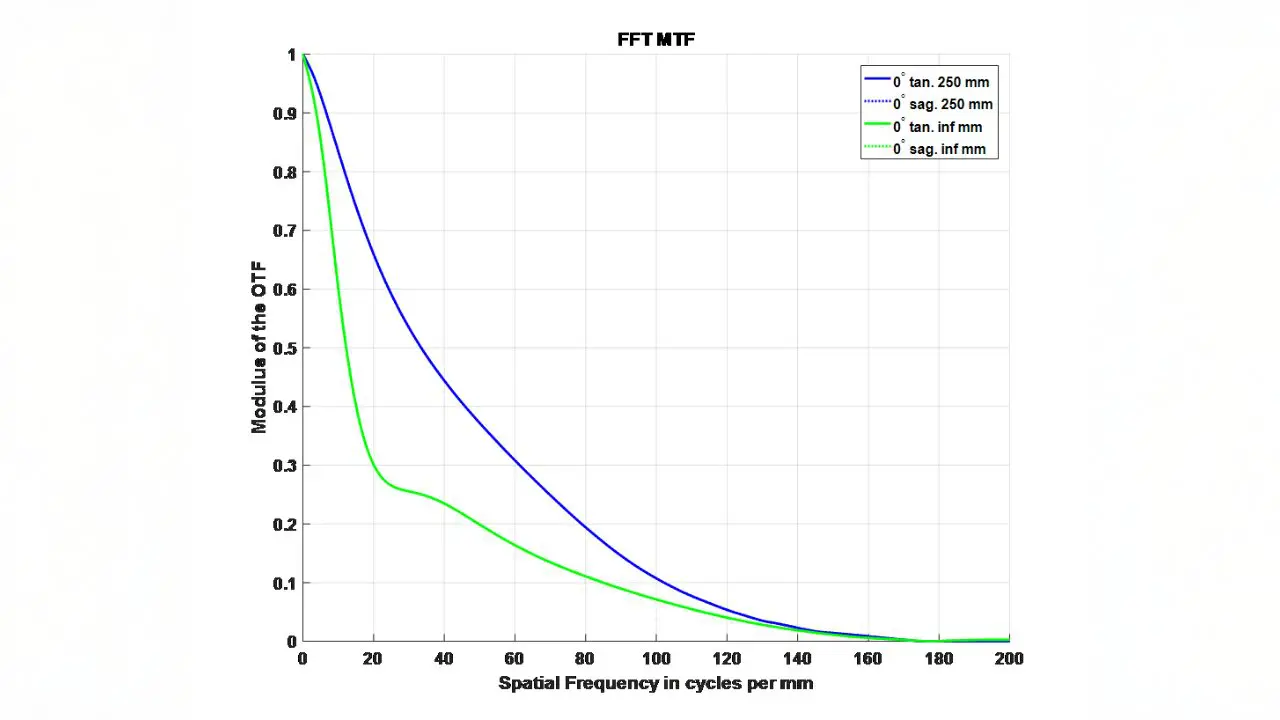
Figure 1: This is a comparison of the MTF performance of a lens evaluated at its correct working finite conjugate (250 mm object distance, blue) versus an incorrect infinite conjugate (green). Measuring off-conjugate introduces severe aberrations, demonstrating the critical importance of replicating the exact application environment during MTF measurements.
The Modulation Transfer Function (MTF) is the gold standard for quantifying the imaging performance of an optical system. Whether you are developing a lens for a medical endoscope, a camera for an autonomous vehicle, or a sighting scope for defense, MTF provides the vital data needed to assess lens quality. Specifically, what MTF measures is the ability of the lens to transfer spatial frequency contrast from the object to the image.
However, generating reliable MTF data requires proper understanding of all imaging parameters, from the lens aperture and wavelength of light to the precise alignment of the system in the test environment. Among these, setting the proper image and object conjugate, which is the distance of the object and image planes with respect to the lens assembly, is often an underestimated factor, but something that is critical for obtaining accurate data.
Imaging systems are engineered to perform optimally at a specific object conjugate distance. When you measure an optical system at the wrong conjugate, you generate data that fuels incorrect assumptions about the overall system performance. This often results in lost engineering hours troubleshooting designs that may be performing correctly, or moving systems into the field with actually poor performance. This single oversight can disrupt an entire design and manufacturing chain.
The Two Biggest Mistakes in Conjugate Testing
In our experience at Optikos, we have noticed two specific errors with respect to conjugate setting in the landscape of MTF measurement mistakes:
- Testing an Infinite Conjugate Optic with a Finite Target: Simulating an object at “infinity” is physically difficult. Engineers often assume that a finite distance such as the hyperfocal distance or simply “100 times the focal length” is a sufficient approximation for true infinity. As we will see, this prevailing assumption is frequently wrong.
- Testing a Finite Conjugate Optic with an Infinite Target: Conversely, configuring a system to measure a lens designed for close-up work (like a machine vision lens) using a standard infinite-conjugate source is a common temptation. While it saves setup time due to test benches already being configured for use, it produces data that does not reflect reality.
Let’s dive into why we need to think about these scenarios and what happens if we ignore conjugation.
Scenario A: The Trap of the “Long Enough” Distance
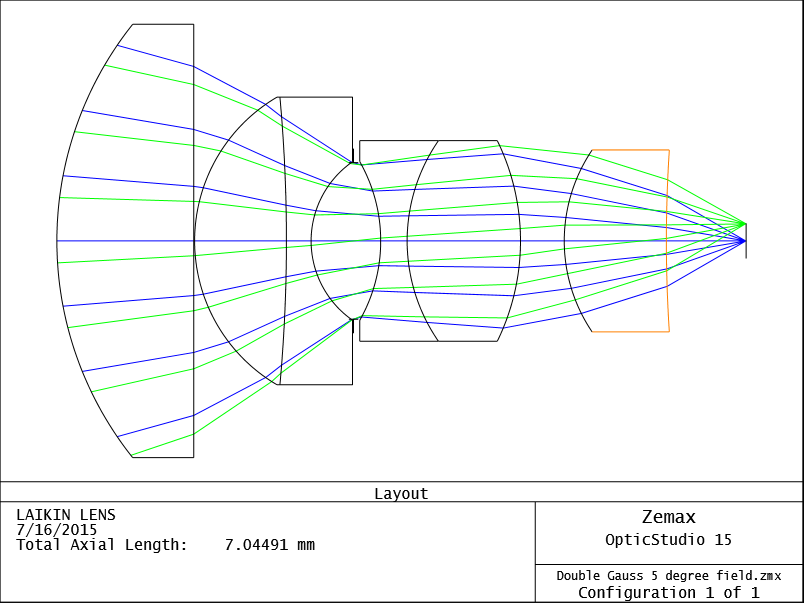
Consider a standard Double Gauss lens (an f/1 lens with an effective focal length of 4 mm), a design common in many imaging applications as showcased in Figure 2. In a theoretical scenario, we might assume that placing a target 400 mm away (100x the focal length) is “far enough” to simulate infinity.
Why the “100x focal length” assumption fails
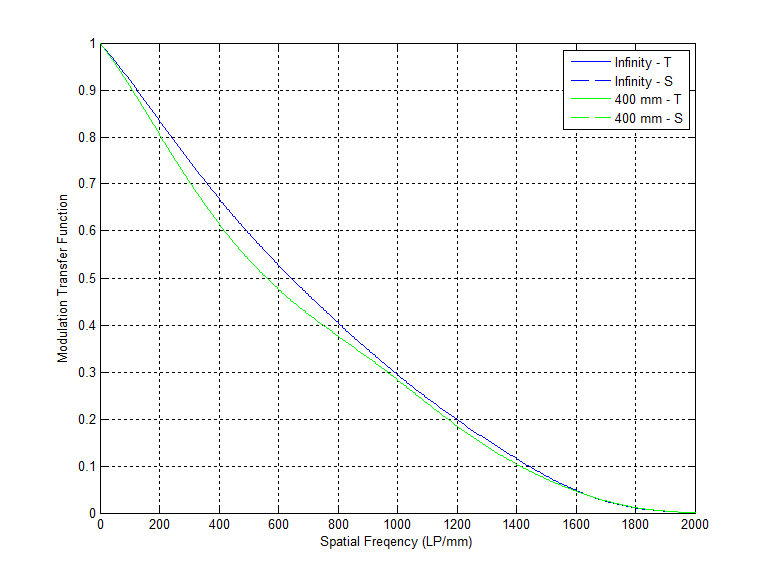
The reality check is that this approach doesn’t work. Using Zemax ray-trace modeling, we uncovered an important difference. When comparing the MTF of this lens at true infinity versus an object distance of 400 mm, the discrepancy is significant, meaning that the difference in performance is large enough to invalidate the test results and cause real engineering problems. At mid-spatial frequencies (200 to 800 LP/mm), the MTF drops by more than 5%, as it appears in Figure 3.
What changes in the optical system
Why does this happen? As you move away from the designed conjugate, the lens experiences focus error. While this might seem minor, it introduces blur that degrades image quality. Furthermore, optical aberrations like spherical aberration and field curvature shift as the object distance changes. The lens is no longer correcting for the angles of light entering it in the way it was designed to.
Why common heuristics fail in metrology
This fallacy translates into many engineers relying on the heuristic: “Multiply the focal length by 100, and you’re at infinity.” In photography, hyperfocal distance is useful for ensuring everything from half that distance to infinity looks “acceptable.” However, in precision metrology, it is not a valid metric. A lens designed for a specific conjugate will not maintain its peak MTF performance at the hyperfocal distance, just as it won’t at 100x focal length. Relying on these approximations risks capturing data that doesn’t reflect the true capabilities of the lens.
What the data actually shows
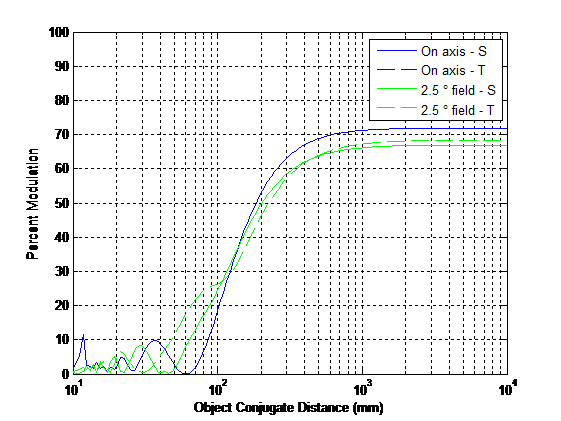
Our data shows this idea can actually lead to erroneous results. For the Double Gauss lens, the MTF only stabilizes to a constant value at object distances beyond 2 meters (Figure 4). If you stop testing at 400 mm because “it’s 100x the focal length,” you are capturing a lens that is still struggling to focus, leading you to believe the lens is worse than it actually is, or, conversely, masking issues that will appear when the lens operates at its intended range.
Scenario B: The Problem of Testing Close-Up Lenses at Infinity
The second scenario is perhaps even more deceptive. Imagine an f/5, 1:1 relay lens (Effective Focal Length or EFL 142 mm) designed to image an object at a specific finite distance (e.g., 250 mm). If you test this lens using a standard infinite-conjugate collimator, the results can be fundamentally invalid.
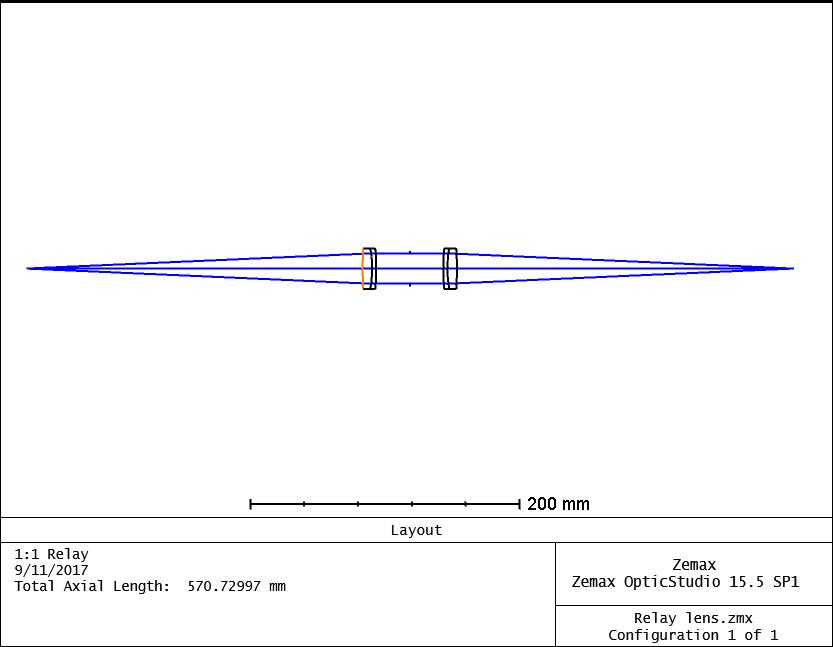
In this case, the discrepancy between the finite conjugate (250 mm) and infinite conjugate data is even more pronounced than in Scenario A (Figure 1). The lens, optimized for a close object, must instead focus on parallel rays. The result? The MTF curve plummets. If the MTF curve plummets, the image produced by the lens becomes:
- Extremely Blurry: Fine details (text, edges, textures) disappear completely.
- Low Contrast: The image looks “foggy” or washed out, even if the lighting is perfect.
- Unusable: The lens fails to resolve the smallest features its design intends it to see.
You might look at the data and conclude, “This lens is underperforming.” In reality, the lens is perfect for its intended job. You simply tested it under the wrong conditions. This leads to unnecessary redesigns, rejected components, and a fundamental misunderstanding of the system’s capabilities.
Why Conjugates Matter from Theory to Application
In geometrical optics Abbe’s sine condition controls off-axis image quality and the related Herschel condition controls on axis image quality at strict geometrical locations and imposes strict constraints on an optical system’s ray transfer—linking image formation to the system’s pupil geometry and the mapping of angles through the optics. Together, they mean that you cannot, in general, design a single optical system to be simultaneously perfectly correct for multiple conjugates (e.g., more than one object distance) and for multiple field positions over a broad field. Satisfying those conditions at one conjugate/field combination tends to “lock in” the system’s fundamental mapping and leaves residual aberrations elsewhere.
As a result, testing at the proper conjugates is not just a practical recommendation—it is essential. When you place the test at the intended object/image distances (and appropriate field points). Otherwise, a measurement taken at the wrong conjugates can mix in defocus/magnification errors, making it appear as though the system is worse than it truly is (or masking the real aberration balance it will have in service). This is why understanding conjugate sensitivity is critical when moving from the lab bench to real-world applications like automotive LiDAR, machine vision, and medical imaging.
Real-World Applications Is Where the Stakes Are High
These optical shifts are where focus errors and aberrations like spherical distortion suddenly spike, creating a blind spot for engineers who rely on generic testing protocols. A lens that passes a standard infinity test may harbor critical flaws that only emerge when the light enters at the steep angles required for close-up work. Consequently, industries where precision is non-negotiable, such as Defense, cannot afford to treat conjugate distance as a secondary variable. Here are three examples of how testing for the right distance makes a difference:
- Automotive LiDAR and Cameras: Autonomous vehicles need to detect pedestrians at 10–50 meters. If you test the camera lens with an infinite-conjugate target (simulating a horizon), you miss the performance characteristics at the critical close-range distances where autonomous systems make safety decisions The lens might look perfect at infinity but fail to resolve a pedestrian at 20 meters.
- Machine Vision & Robotics: Robots assembling electronics often work at fixed, close ranges. Testing these lenses at infinity yields data that has zero correlation to the robot’s actual ability to read a barcode or align a component.
- Medical Endoscopes: These systems operate at very short, finite distances inside the body. Testing them with infinite targets would render the MTF data useless for surgical planning.
The Solution: Match Your Test to Your Use Case
The lessons are clear. You must test the lens under the conditions in which the application will operate.
Infinite Conjugate Systems
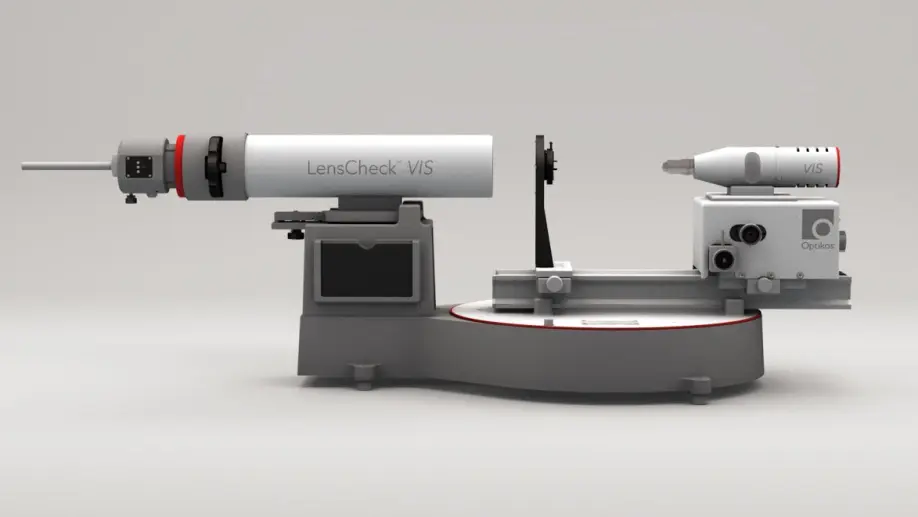
For infinite conjugate systems, this means that if you are testing a lens designed for infinity (like a telescope or a long-range surveillance camera), do not rely on common fallacies for your test distance. You must model the MTF performance to determine the actual minimum object distance required to simulate infinity for that specific design. At Optikos, we use our OpTest ® and LensCheck™ systems, which can be upgraded for precise afocal measurements, ensuring the target is truly at infinity or at a verified distance.
Finite Conjugate Systems
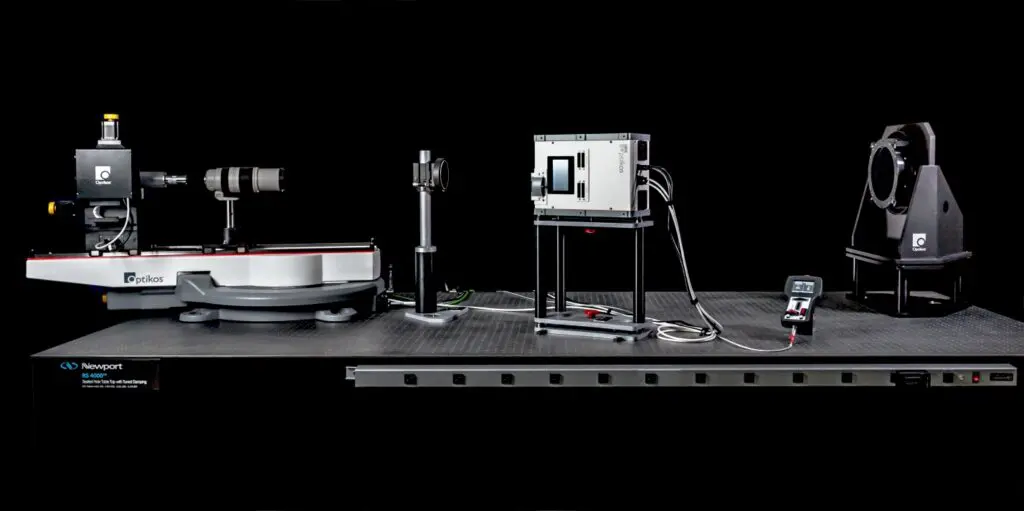
For finite conjugate systems, if you design your lens for a specific distance (like a 1:1 relay or a close-up inspection lens), you must use a finite conjugate test platform.
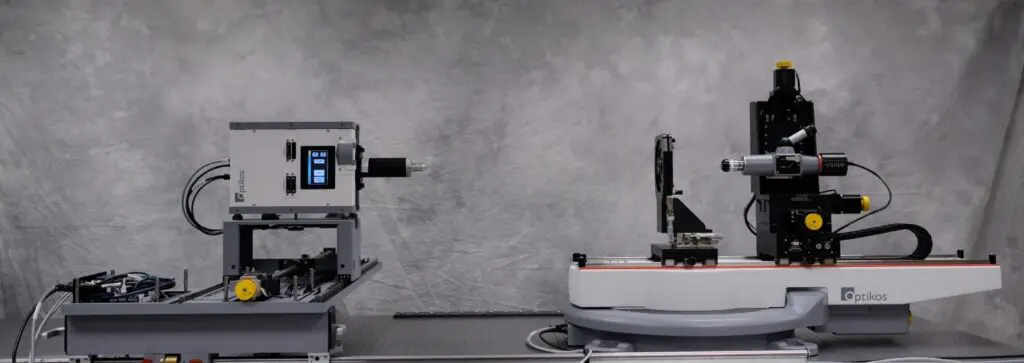
Executing a precise finite conjugate test demands rigorous alignment, where you position the light source at the exact object distance and the detector locked to its corresponding image plane to avoid introducing artificial blur. Fortunately, modern metrology platforms like the finite conjugate variants of the LensCheck and OpTest systems simplify this challenge by incorporating translatable sources that allow engineers to dial in object distances with micron-level precision, seamlessly simulating scenarios ranging from 10 cm to several meters. For even more complex applications, such as validating automotive LiDAR or high-volume camera production lines, advanced solutions like the Meridian™ Production Camera Test System take this a step further. These systems employ sophisticated target generators capable of projecting images at dynamically adjustable conjugate distances, effectively recreating the specific real-world optical environments that the final product must navigate.
Custom Solutions for Complex Needs
What is important to note is that not every optical system fits a standard box. The unique geometries of specialized instruments often demand bespoke solutions that go beyond off-the-shelf configurations.
Take endoscopes, for instance, where the extreme proximity of the object and the intricate physical constraints of the device require us to engineer entirely custom testing platforms tailored to their specific finite conjugates. Similarly, when a lens must perform reliably across a spectrum of distances rather than a single point, we deploy adjustable conjugate LensCheck systems capable of automated, multi-distance scanning.
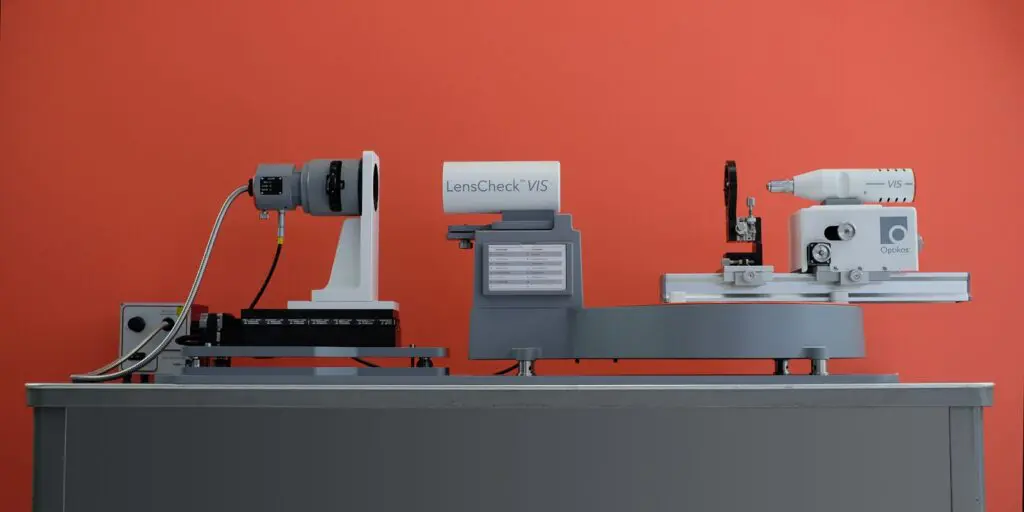
These custom approaches ensure that whether the challenge is a microscopic medical probe or a lens with a wide operational envelope, the test environment is meticulously sculpted to mirror the exact realities the device will face in the field.
Our Conclusion: Don’t Guess, Measure Correctly
In the race to bring optical products to market, it is tempting to cut corners, especially on testing. But when it comes to MTF, conjugation is the foundation. Whether you are validating a new camera sensor, qualifying a medical device, or certifying an autonomous vehicle sensor, remember:
- Define Your Conjugate: Know exactly where your lens is designed to focus.
- Match Your Test: Use a target at that exact distance or range.
- Avoid Assumptions: Never assume “infinity” is 100x focal length without modeling.
At Optikos, we provide both finite and infinite conjugate test platforms tailored to your specific needs. Because in optics, the difference between a successful product and a failure often comes down to the distance between the lens and the target being measured right.
For more information on Optikos MTF testing products and custom services, visit our dedicated Products and Solutions page.
Revised:
| Originally Published: November 9, 2020