Optikos created a custom polarimeter that enabled ultra-precise polarization metrology for semiconductor lithography systems, transforming a one-off solution into a 12+ year production partnership for advanced chip manufacturing.
Key Achievements:
1. Ultra-High Extinction Ratio
Delivered >50,000:1 extinction ratio which far exceeds typical PBS cubes (1,000–2,000:1) while meeting specifications considered borderline impossible.
2. Micro-Radian Angular Calibration
Established the intended polarization axis calibrated to within thousandths of a degree using proprietary alignment methodology that persists across instrument lifetimes.
3. 12+ Year Production Partnership
The one-off project turned into a sustained supply relationship (~2 systems/year), with continued deployment throughout newer tool generations which validates the longevity of the original design.
Summary
The Problem
A global semiconductor equipment manufacturer required a custom polarization metrology tool with >50,000:1 extinction ratios and micro-radian accuracy with the aim of qualifying next-generation lithography systems. No commercial solution existed that met these extreme specifications or compact form-factor constraints.
The Solution
Optikos engineered a custom polarimeter using high-performance optics and a proprietary calibration methodology to deliver unprecedented measurement stability. This bespoke system precisely established polarization axes relative to mechanical datums with nanowatt-level resolution.
The Result
The tool exceeded all performance specifications and evolved from a one-off project into a 12-year recurring supply partnership. It continues to enable reliable qualification of advanced chip manufacturing equipment across multiple generations.
About the Customer
A global manufacturer of advanced semiconductor lithography systems (which are the essential equipment used for producing cutting-edge microprocessors) approached Optikos with an exceptionally demanding metrology need. As the supplier of extreme ultraviolet (EUV) lithography tools used by leading chip fabrication facilities, this customer operates at the technological edge where sub-nanometer precision determines yield and profitability.
Industry: Semiconductors; Optical Metrology; Advanced Manufacturing
The Challenge
The customer’s lithography qualification system required the measurement of polarization states at two critical points:
- Z-plane wavefront – where a Fizeau interferometer establishes the optical wavefront quality;
- Pupil camera – where reflected beams from the measurement system must have known polarization characteristics for accurate sensing, a sensitivity that is needed to measure complex, sub-wavelength 3D semiconductor features in a single snapshot.
The specifications presented for the polarization tool were disruptive for the industry at the time:
| Specification | Requirement | Typical Industry Benchmark |
| Extinction Ratio | ≥50,000:1 | 1,000–2,000:1 (PBS cubes) |
| Angular Accuracy | Thousandths of a degree | Not typically specified |
| Power Resolution | ~1 nanowatt | 1–100 microwatts (standard photodiode range) |
| Form Factor | Compact, pupil-camera fit | Constrained by existing optics |
| Calibration Stability | Multi-year retention | Periodic recalibration typical |
Why This Matters
As Nathan Wallace, Director of Engineering Services at Optikos, explained:
“When you’re dealing with laser systems, which are highly polarized, polarization is a very great trick for getting high efficiency for splitting and doing returns. So, if I know my axis of polarization and I’ve aligned it really well, then all of my downstream optics should work efficiently.”
In semiconductor lithography metrology, uncontrolled polarization introduces errors in overlay alignment, critical dimension measurements, and focus detection, all of which translate to lower yields and higher manufacturing costs at advanced nodes (such as those with sub-10nm features).
The Solution
Rather than chase exotic optics for this project, the Optikos team applied a well-understood calibration method to its limits. By using a rotating Glan-Thompson polarizer paired with nanowatt-resolution power detection that could confirm alignment by balancing signals across 180° rotations, the Optikos team of experts came up with a technique that most optical engineers have never attempted at this scale. The applied principles that made this polarimeter fit into the larger metrology tool design included:
1. A Glan-Thompson Polarizer Architecture
The core of the system utilized a Glan-Thompson polarizer constructed from two calcite crystals cemented together with specialized optical adhesive. Calcite’s natural birefringence enables separation of ordinary and extraordinary rays through total internal reflection:
- One polarization state passes through with minimal loss;
- The orthogonal state is rejected via internal reflection.
This architecture inherently achieves superior extinction ratios compared to conventional PBS cubes (1,000–2,000:1).
2. A Rotary Stage with Camera Detection
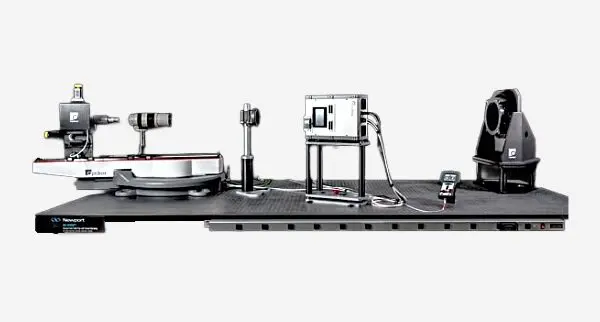
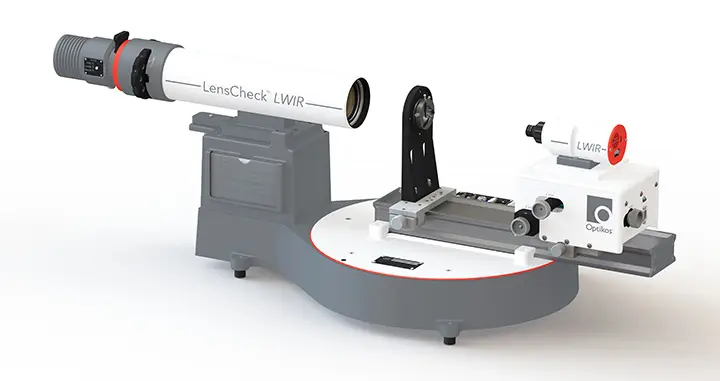
A motorized rotary stage held the Glan-Thompson polarizer, rotating it incrementally around the beam path. At each angular position, a camera-based detector captured the transmitted light intensity. By sweeping through a range of orientations and recording intensity at each step, the system mapped how transmission varied with angle—revealing the complete polarization state of the incoming beam. Peak transmission indicated alignment with the polarization axis; minimum transmission indicated perpendicularity, with the contrast between the two defining the extinction ratio.
3. Proprietary 180° Flip Calibration Method
To establish absolute reference for the polarization axis, Optikos implemented a differential power balancing technique:
“The best way to do this is to actually put in a linear polarizer and measure what the value is, then flip it around 180 degrees. If I balance the power between the two states, then this is my axis of polarization for that beam.” — Nathan Wallace
By rotating the polarizer to opposite orientations and balancing power measurements to within nanowatt precision, the system determined the exact polarization axis relative to mechanical datums with micro-radian accuracy.
4. Brewster Window Integration
To guarantee pure polarization states during calibration, Optikos incorporated Brewster-angle windows that allow p-polarized light to transmit while reflecting s-polarized components. This ensured measurement integrity without contamination from spurious polarization states.
The Results
Optikos exceeded all client specified requirements:
| Performance Metric | Target | Result | Notes |
| Extinction Ratio | 50,000:1 | ~50,000:1 (system) | Camera/sensor limited; polarizer capable of 100,000:1 |
| Angular Accuracy | Thousandths of a degree | Within thousandths of a degree | Calibrated to mechanical datum |
| Power Resolution | Nanowatt level | Within 1–2 nanowatts | Used during 180° balancing alignment |
| Minimum Threshold | 25,000–30,000:1 | Met consistently | Customer’s absolute minimum requirement |
Achieving Commercial Success
What began as a one-time development effort evolved into a sustained production:
- Initial order: 1 system
- Follow-on orders: 2 additional systems
- Sustained rate: ~2 systems per year for 12 years
- Continued relevance: The tool remains unchanged for newer platforms, demonstrating robust design longevity.
“We ended up making a custom polarimeter with very high sensitivity that was fully calibrated and maintains the axis polarization to a high degree.” — Nathan Wallace
Customer Value Delivered by Optikos:
- Eliminated need for alternative calibration approaches
- Enabled qualification of next-generation lithography tools without redesign
- Provided confidence in downstream optical performance
- Reduced total cost of ownership through durable, proven design and durability
Conclusion
Optikos distinguished itself through three critical competencies:
1. Deep Polarization Physics Knowledge
While many optical engineers work with polarized light, few possess the depth of understanding required to implement sub-nanowatt power balancing techniques and Brewster-angle optimization for absolute calibration.
2. System-Level Integration
The solution ended up being a complete metrology subsystem including capabilities such as rotary mechanics, camera detection, calibration methodology, and mechanical datuming that ensured long-term repeatability.
3. Ready-for-Production Design
Unlike usual prototypes, the Optikos team engineered the tool design for multi-year operational stability and compatibility across evolving product generations—a rarity for custom metrology solutions.
Why This Matters for Semiconductor Manufacturing
As semiconductor features continue to shrink, lithography metrology precision becomes increasingly critical. Without precise knowledge of the polarization state in these systems, polarization-dependent optics such as PBS cubes operate unpredictably, factors like scatter and stray light can introduce measurement noise, and systematic errors accumulate through the process chain—all of which directly impact yield.
“Such a project shows we know how to work with polarized light. We were tasked with designing a custom polarimeter that went into an already compact pupil camera location, and we delivered something that met all those stringent specifications.” — Nathan Wallace
Ready to Talk about Your Project?
The polarimeter exemplifies the ability of the Optikos engineering experts to tackle specifications that lie beyond standard commercial capabilities. The polarization tool became a trusted component within a sophisticated semiconductor manufacturing ecosystem, deployed across successive generations of equipment and validated by sustained repeat business for the client.
For organizations facing similarly demanding metrology challenges in semiconductor manufacturing, aerospace, quantum systems, or advanced optics, we invite you for a call to discuss the challenges your team is facing. Get in touch at (617) 354-7557 or [email protected].