Heuristics Are Making Way for Hard Data in the Nightforce Optics and Optikos Partnership
Date
September 25, 2026
Author
Daniela Dandes
Time
5 min
Share this Post
At A Glance:
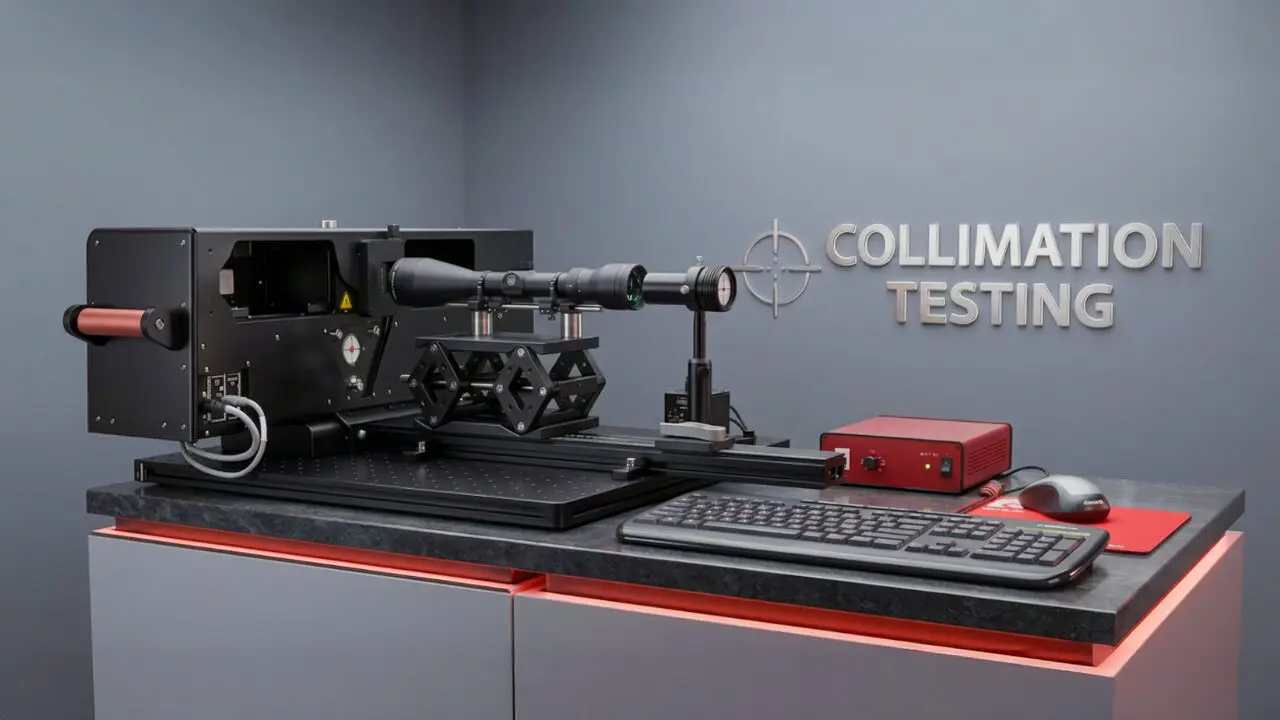
Nightforce Optics integrated the Optikos ColliMeter™ for Riflescopes to achieve ISO-certified, traceable verification of master reference scopes. The independent metrology system replaces heuristic calibration with quantitative data on minimum parallax accuracy and optical alignment.
Precision rifle optics demand high-stakes quality assurance. That’s because the difference between a winning shot and a miss often comes down to fractions of a millimeter. For decades, manufacturers in the industry have relied on the expertise of experienced technicians, validated engineering processes and precision measurement tools to ensure their scopes are properly collimated. However, as the demand for absolute accuracy grows, particularly for regulated applications with low error margins, independent, traceable verification of master reference scopes provides an additional level of confidence and documentation.
Enter the ColliMeter for Riflescopes, a breakthrough instrument developed by Optikos that provides an independent, ISO-certified method for verifying critical reference standards. Recently, Nightforce Optics, Inc., a market leader known for its rugged, high-performance scopes used by military snipers, competitive shooters, and hunters, took a pivotal step forward by integrating this technology into a project requiring ISO-certified verification of its master reference scopes.
We sat down with Kali Gagné Morici, Optical Engineer Supervisor at Nightforce Optics, to discuss why they sought out a solution like the ColliMeter, how the partnership with Optikos unfolded, and how the new data has impacted their project.
Q: Kali, thank you for joining us. Could you walk us through the initial driver for your team to reach out to Optikos? What specific need led Nightforce to seek out a product like the ColliMeter?
Kali Gagné Morici (KGM): Glad to be here. The primary driver was our need for an ISO-certified solution. We have a set of “master scopes” that we use to establish object distances within our own collimation systems, specifically for regulated applications. Historically, verifying the accuracy of these references relied on methods that, while skilled, lacked the rigorous documentation required for our compliance standards. We needed to find a way to objectively verify and document their accuracy, and that’s what the Optikos ColliMeter provided. The device gave us an independent, ISO-certified method to verify and document the accuracy of our master reference scopes, providing the traceability and documentation needed to support our project.
“[The ColliMeter] gave us an independent, ISO-certified method to verify and document the accuracy of our master reference scopes, providing the traceability and documentation needed to support our project.”
Kali Gagné Morici, Optical Engineer Supervisor at Nightforce Optics
Q: When you were evaluating potential solutions, what was the single most important performance metric your team was looking for?
KGM: It came down to the accuracy of the set object distance. Specifically, we needed to know how closely the minimum parallax setting of a scope would be aligned with the actual intended distance. In many cases, marketing claims or dial settings would say “100 yards,” but the optical reality can be more like 125 yards or something similar due to calibration offsets or aberrations. For our master scopes, ensuring that those reference points were accurate was, and is, critical for us. If the baseline is off, every subsequent measurement in our system is compromised. We needed the ColliMeter to quantify that deviation with extreme precision.
Q: Can you describe how the ColliMeter for Riflescopes helped you achieve that from a data perspective? What did you see that you couldn’t see before?
KGM: The ColliMeter gave us the ability to quantitatively verify the accuracy of our master scopes’ distance settings. The measurement data allowed us to identify calibration deviations and understand the effects of optical aberrations better. Having that level of quantitative data gave us additional confidence in our reference standards while also providing the traceability and documentation we needed for the project.
Q: Adopting new metrology equipment can sometimes be challenging. How was the integration process? Did your team require significant support from Optikos to get things up and running?
KGM: The adoption process was surprisingly seamless, largely because of how we engaged with Optikos from day one. We worked directly with the engineering team, and they evaluated and adjusted our master scopes by using their on-site system. They handled the entire setup process efficiently and maintained clear communication. What we experienced from Optikos was far from a “figure it out yourself” case. The fact that our interactions were collaborative ensured that smooth adoption, which you can only get if the team on the other side is interested in understanding your specific product and context.
“What we experienced from Optikos was far from a “figure it out yourself” case. The fact that our interactions were collaborative ensured that smooth adoption, which you can only get if the team on the other side is interested in understanding your specific product and context.”
Kali Gagné Morici, Optical Engineer Supervisor at Nightforce Optics
Q: Reliability is also important with metrology applications. How would you rate the reliability of the data produced by the ColliMeter with your scopes?
KGM: We found the data to be highly reliable, particularly in the extended distance ranges where our application requires the tightest tolerances—several kilometers in some cases. The results aligned with our internal expectations for known reference units. What really reinforced our confidence, however, was the supporting documentation on the Optikos measurement methodology. Knowing how the data was derived and having traceability to standards made the numbers trustworthy.
Q: Looking back on the collaboration, are there any specific feedback points you’d like to share? What stood out about the experience, and what are some areas for growth that you’ve noticed?
KGM: The standout element was the responsiveness and technical depth of the Optikos team. The people we interacted with were knowledgeable, easy to work with, and provided documentation tailored exactly to our needs. They made the necessary adjustments to our scopes efficiently, and the entire process was straightforward. If I had to offer a suggestion for the future, it would be about continuing improvements in long-distance accuracy. That would further enhance the system’s capabilities.
Q: Could you summarize the role the ColliMeter for Riflescopes plays in your broader projects today?
KGM: Its role has been very important in moving our initiatives forward. The ColliMeter played a substantial part in enabling us to validate our master scopes through an ISO-certified process. That certification was a key requirement for our project, and the device delivered on it. It gives us confidence that our reference tools are accurate, which in turn supports the integrity of the collimation systems we deploy.
Q: Finally, do you have any last thoughts about your overall collaboration with Optikos?
KGM: I appreciated the fact that Optikos has proven to be a strong partner for our team. We worked in a really responsive environment with technically knowledgeable people, and it was genuinely easy to work with the team. This is especially valuable when timelines are tight and requirements are highly specific, as they were for us. Throughout the process, the Optikos engineers took the time to answer questions thoroughly, explain their methodology clearly, and ensure that we would be confident in both the measurements and the resulting documentation. One thing we especially appreciated was the open communication and the willingness to work collaboratively to meet our project needs throughout the process. Overall, our experience with both the Optikos team and the ColliMeter process was very positive.
The partnership between Nightforce Optics and Optikos demonstrates the value of complementing established engineering processes with independent, traceable metrology. By providing ISO-certified verification of critical reference standards, the ColliMeter helped support the project requirements for Nightforce Optics while providing additional confidence in the accuracy of the master reference scopes.
Work with our experts today on your collimation challenges for full project precision.
Share this Post
See More Posts
Blog
Q&A: From Components to Complete Optical Subsystems: The Novanta and Optikos Collaboration
07/22/2026
•
7 min

Blog
Optikos Achieves Zero-Finding
ISO 13485 Recertification: A Conversation with Nick Mastrocola, Quality Manager at Optikos
07/13/2026
•
6 min
Blog
Advancing Automotive Imaging and Thermal Testing Insights from AutoSens USA 2026
06/24/2026
•
5 min