
That Extra Monte Carlo Tolerance Analysis Just Might Save Your Next Defense Project
Date
May 12, 2026
Author
Daniela Dandes
Time
4 min
Share this Post

“New customers don’t always think about stuff like this,” said David as he was pulling up a Monte Carlo analysis graph on the screen. “Especially if they’re planning on volume-scale manufacturing, this data is crucial.”
Dr. David Biss, Senior Manager of Optical Engineering at Optikos, was talking about a surveillance system that his team designed to reach nearly diffraction-limited performance. This device was going to be deployed in a performance-critical defense project, so its capabilities had to operate with absolute certainty. This meant that the optics behind the equipment couldn’t miss a single pixel. And that was a problem with this initial build. David and his team quickly identified that the optical output was not delivering the expected outcome because the measured performance data did not match simulated build performance. Their verdict? A non-compliant optical element was ruining the overall system performance.
Why Early Monte Carlo Analysis Matters
The usual design process that the Optikos engineering team follows includes Monte Carlo build simulations and rigorous metrology tests that verify performance. In the case of this surveillance system, the analysis revealed a large error in the manufacture of individual lens elements. This error introduced optical aberrations in the system that reduce contrast and resolution, particularly at the edges of the field of view (FOV). For an application that requires a wide FOV, and consistent performance across the full FOV, such as the one David’s team was handling, leaving the system in its initial state was not acceptable. But realistically speaking, this kind of problem represents a more common status quo for companies that rely just on standard design processes without the extra design and metrology steps for outcome verification.
“One of the most important aspects of our work,” David continued, “is that we test everything. We don’t like to leave things at face value because that’s not what engineering is about. Basically, what sets Optikos apart from any other optics service provider is that we take the time to explain the why behind our testing and simulation processes. Even better, we have the stories to empirically prove why we stick to our method of working with our clients, looking at both good case practices and situations you’d want to avoid. That’s how veteran customers of Optikos have a better sense for what they should be looking for when talking about optical performance for their systems.”
What the Performance Data Reveals
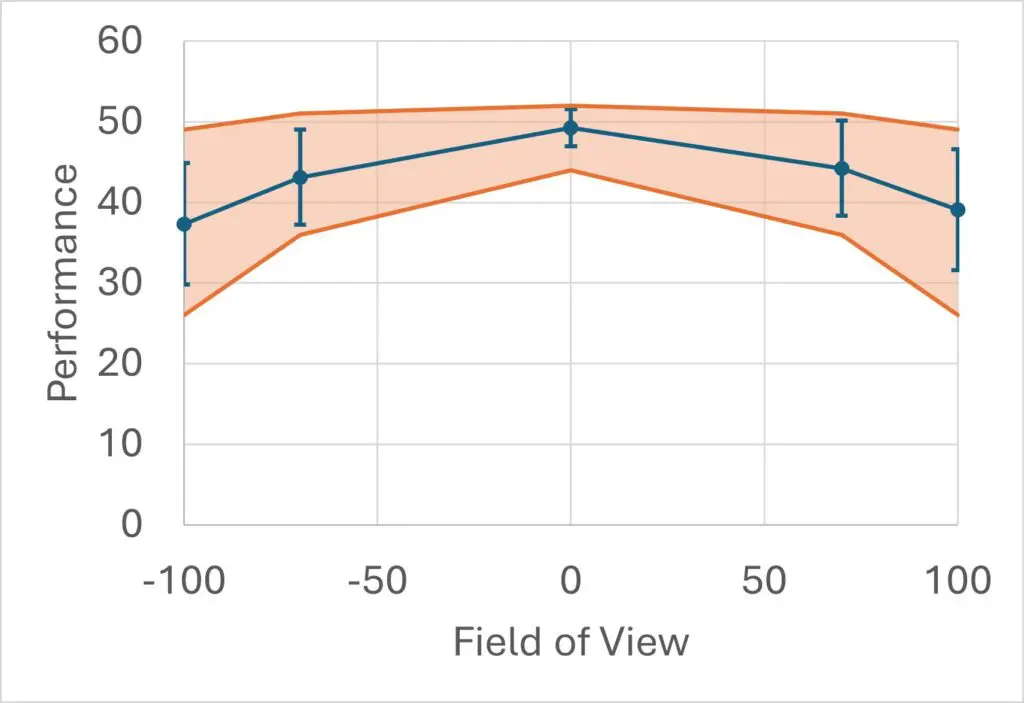
Let’s get more concrete about the difference a metrology-mindset can bring to defense optics (and optics in general). For example, David created the plot above to exemplify modeled “statistical build” performance based on historical analyses of lens and camera systems. The graph, with its performance and field of view axes, represents the expected performance range of the tested optical systems.
“The blue line and its error bars tell the real story,” David observed. “They track the actual performance of the as-built system across that entire field of view. Notice how tightly the blue line hugs the prediction band? That alignment is the metric of success we’re eyeing. It means the performance of the ensemble optics based on the optical design is on point regarding the desired outcome, which can later cascade into a manufacturing process that isn’t a gamble. These simulations offer the client the reassurance that what they’re getting is a predictable, controlled variable in their overall business process.”
“Notice how tightly the blue line hugs the prediction band? That alignment is the metric of success we’re eyeing.”
—Dr. David Biss, Senior Manager of Optical Engineering at Optikos
David thinks that through the extensive metrology approach at Optikos, “we are proven right in having a good understanding of our design process, which means lower prices, faster delivery times, and consistent supply of high performing product for our partners. And that’s what everyone wants.”
For defense contractors and program managers, these graphs should represent factual risk-mapping tools. They illustrate if the aerial imaging system can deliver consistent high-contrast imagery across the entire field of view. By visualizing the difference between a good-enough design and a high-performing, manufacturable one, we ensure that every surveillance payload performs exactly as expected or even exceeds expectations.
Design for Manufacturing: Getting It Right from the Start
“We always start with the question of how you manufacture these optical systems. For defense in this case, you’d want to get the highest image performance possible, which is becoming a more complex puzzle to solve. Think about how payloads are getting smaller, but the FOV needs to be wider. So, in the context of complex optical systems, we want to run tests and see what works. Even if it’s for one simple design, we adopt a design-for-manufacturing mentality anyway. That is also how metrology, the act of testing what usually gets left out, sits as the base of our activities. You get it right from the get-go and you never have to look back on your optical design,” concludes David.
By validating that as-built components match simulations before mass production, clients secure the reliability that their missions demand without sacrificing speed or budget. In high-stakes environments, this upfront investment in testing guarantees a successful deployment.
Want to learn more about the importance of metrology in the design and manufacturing processes for optics? Check out David’s webinar; Metrology as a Mindset: Engineering for Success.
Share this Post
See More Posts
Blog
Heuristics Are Making Way for Hard Data in the Nightforce Optics and Optikos Partnership
09/25/2026
•
6 min
Blog
Q&A: From Components to Complete Optical Subsystems: The Novanta and Optikos Collaboration
07/22/2026
•
7 min

Blog
Optikos Achieves Zero-Finding
ISO 13485 Recertification: A Conversation with Nick Mastrocola, Quality Manager at Optikos
07/13/2026
•
6 min