Non-Negotiables for Space: Testing Optics via Vacuum-Compatible Metrology Solutions
Date
March 26, 2026
Author
Daniela Dandes
Time
4 min
Share this Post
Walk down the hallways at Optikos, and you’ll hear a question that keeps bouncing off the walls like a photon in a Fabry-Pérot cavity: “Sure, we can build that system. But will it truly solve the problem for our clients?“ It’s the kind of question that cuts through engineering bravado and lands squarely on what really matters: the fact that precision only earns its crown when it translates into outcomes that make a difference for the end user. For example, a critical sector where that ethos is put to the test is the space industry, where results become either missions that excel or projects that go dark.
Making Sure What You See Is What You Get
In image-based space applications, image performance sits at the top of the priority list. Whether the payload operates in the ultraviolet or stretches into long-wave infrared, any visual, image-forming, or light-collecting device demands rigorous validation to ensure the delivered outcome is of top quality. From a performance standpoint, the collected energy must match expectations or, at minimum, be calibrated with absolute certainty to the required specifications. As Nathan Wallace, Director of Engineering Services at Optikos, puts it: “With space payloads, imagine I have an optical system which inherently needs to be taking a picture in a different environment than what we have on Earth. For a regular lens, I can put it on our OpTest® bench from Optikos, hit the ‘go’ button to get MTF (modulation transfer function) data and that will tell me if the visual result is matching my expected quality. But for space, I don’t know if the picture will be good or not in the new conditions. You need to test things differently to get that answer.”
Introducing Vacuum-Compatible Measurement Solutions
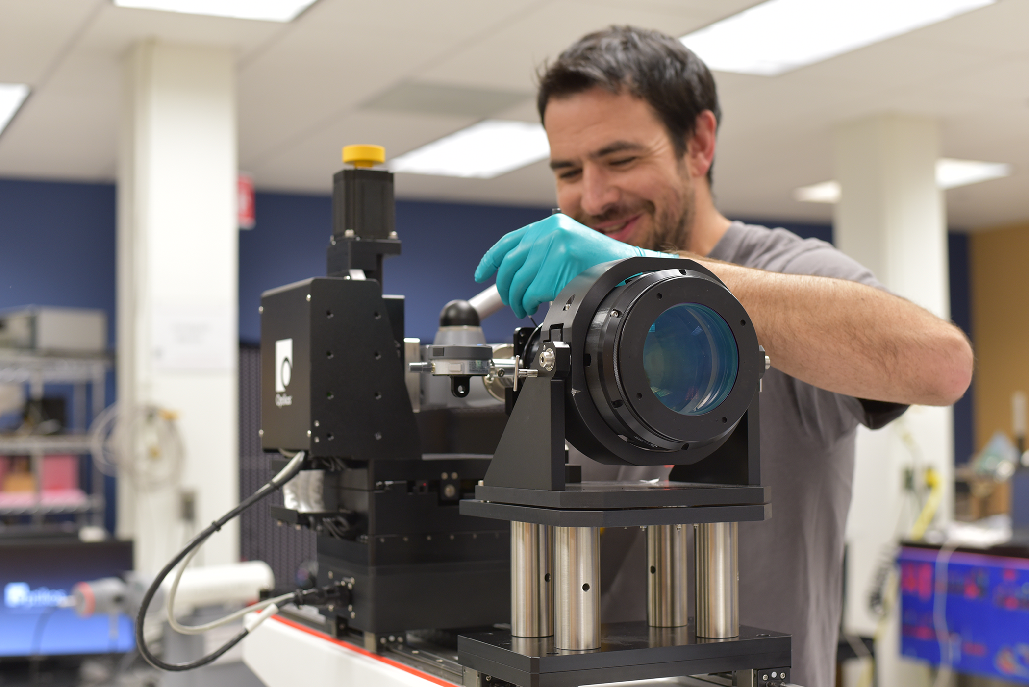
While a lens might perform flawlessly in a controlled lab environment, the vacuum of space introduces a unique set of variables that can change optical path lengths, have adverse effects on coatings, and alter thermal properties in ways air-based testing simply cannot replicate. In light of this, the Optikos engineering team has developed high-precision electro-optical metrology equipment built specifically for vacuum environments. A complete suite of instruments has been engineered to meet NASA’s low outgassing (TML/CVCM) requirements that can deliver the expected data regarding image quality. The vacuum-compatible offering includes collimators, target generators, multi-spectral light sources, and black-body sources for infrared testing. It is important to note that every component uses space-flight heritage materials which ensure performance in a vacuum environment without any contamination risk to the payload under test.
We Understand the Risks
These types of design details keep our engineers proverbially awake at night. As Nathan Wallace notes, “Here’s the reality that keeps optical engineers on their toes. From this point of view, I would be terrified that all of the thermal management that I have prepared for with testing in air will behave entirely differently in a vacuum environment. Even If I get a success in a lab, let’s say on that OpTest® bench I mentioned earlier, will the payload work as intended in space?”
Beyond thermal concerns, there’s the question of focal plane positioning, as Nathan noted, “Then I would have to think if I got the focal plane in the right position. If I use a Starfield-type system and I get the focal plane in the right place, am I sure I got the right focus? Because the index of refraction changes in air versus in vacuum.” These are major compromises that customers who test their space optical systems in air must work through. They have to carefully map the in-air focal plane, ensure their model predicts where the focal plane will be, launch the project—and hope for the best.”
So, We Prepare for Client Confidence with the Right Data
While the risks of testing in air are daunting, Nathan is quick to point out that the answer lies in properly replicating the reality of space throughout the testing phase, not only when designing the payload. He frames the challenge clearly: “The problem for our customers is that they have high-end optical systems—image-forming lens systems, usually paired with a detector—that need to perform exceptionally well. They need the confidence that their system will perform in the environment it’s meant to operate in.” For Nathan, the path forward is uncomplicated: “Our solution offers the only way to test that through our space-grade metrology solutions for clients to gain confidence that their system will work the first time. How do we achieve that? By taking the test equipment and putting it directly in that environment.”
By moving the test infrastructure from the lab to a high-vacuum chamber, Optikos transforms the terrifying uncertainty of “will it work?” into the assured certainty of “we know it does.” This gives our clients confidence in their payload launches, because the system is set up to arrive in orbit ready to perform.
Precision That Performs in Orbit
As more satellites launch and constellations grow, the demand for reliable, high-performance optical systems will only intensify. This expansion makes vacuum-compatible metrology part of the essential infrastructure for the next generation of space-based operations. The vacuum-compatible metrology solutions from Optikos enable this confidence by validating image quality and thermal performance under conditions that mirror actual orbital operations. In an industry where every mission carries significant investment and expectation, that confidence is the critical performance metric. So, you don’t want to hope it works. You want to know it does.
Download our TVAC‑compatible systems one‑pager for more information on our capabilities.